skip to main |
skip to sidebar
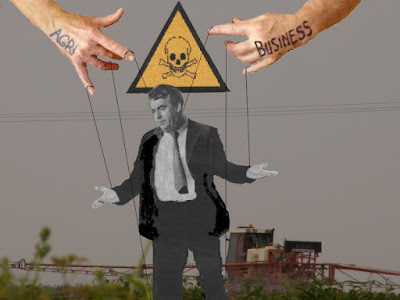 This is really about the lack of Gordon Brown's plans for the future of agriculture and the agricultural environment. Given the urgency of the need to create strategies for energy, efficiency and production in all fields(excuse the pun), there is almost a deafening silence from government. There are the occasional suggestions for using low energy light bulbs, but that's about the extent of their creative thinking. Let's have some concerted planning and incentives for really moving away from our dependence on oil! In relation to farming I wonder if Gordon is going to opt for the environmentally sustainable option, or whether he will cave in to the agri business ,or the GM biotechnology industry.It's a sobering thought that 75% of the UK is agricultural land and 31,000 tons of pesticides are sprayed on UK land every year......" The toxicity of pesticides used in agriculture has increased by an estimated factor of 10-100-fold since 1975.Despite this, resistence is spreading; POPS (persistant organic pollutants)are becoming less effective: they accumulate in the food chain, persist in the environment and travel by being bioaccumulated (as animals eat each other, so the POP is stored in fat and thus consumed and stored).Pesticides are a key route for POPS,, notably through aldrin, chlordane,DDT, dieldrin, endrin and heptachlor. 1000 species of insects, plant diseases and weeds are now resistant, an environmental impact known as the 'treadmill effect'." Rain water in parts of Europe contains such high levels of dissolved pesticides it would be illegal to supply it as drinking water.So, Gordon, what's it to be? Give us a clue.Text in blue is information taken from 'Food Wars' by Tim Lang and Michael Heasman.
 There is an interesting article by Megan Quinn called 'The Power of Community:How Cuba Survived Peak Oil.' It features on the website of Global Public Media. I'll just quote a little bit about farming in Cuba, but her article is well worth reading for other aspects of cuban life......"Havana, Cuba--At the Organiponico de Alamar, a neighborhood agriculture project, a workers collective runs a large urban farm, a produce market and a restuarant. Hand tools and human labour replace oil-driven machinary. Worm cultivation and composting create productive soil. Drip irrigation conserves water, and the diverse, multi-hued produce provides the community with a rainbow of healthy foods. In other Havana neighborhoods, lacking enough land for such large projects, residents have installed raised garden beds on parking lots and planted vegetable gardens on their patios and roof tops.Since the early 1990's an urban agriculture movement has swept through Cuba, putting this capital city of 2.2 million on a path toward sustainability.A small group of Australians assisted in this grass-roots effort, coming to this Caribbean island nation in 1993 to teach permaculture, a system based on sustainable agriculture which uses far less energy.This need to bring agriculture into the city began with the fall of the Soviet Union and the loss of more than 50% of Cuba's oil imports, much of its food and a percent of its trade economy.Transportation halted, people went hungry and the average Cuban lost 30 pounds.........Cubans are also replacing petroleum-fed machinary with oxen, and their urban agriculture reduces food transportation distances. Today an estimated 50% of Havana's vegetables come from inside the city, while in other Cuban towns and cities urban gardens produce from 80% to more than 100% of what they need......"Please read the rest of the article, it's interesting.
The average western adult contains between 300 and 500 traces of man-made chemicals in their bodies. Before the second world war there were none.During the war in this country there was a need to increase food production, and so the use of pesticides and fungicides began.After the war 4000 farmers were disposessed of their land by government because they wouldn't farm in the intensive way that government wanted them to. The government brought in legislation- 'The 1947 Agricultural Act' to make farmers adopt the use of chemicals and technology for high crop production.There is no longer any necessity for this sort of intensive agriculture but government persists in their mantra that the more chemicals and technology are applied in agriculture, the more food will be produced and the lower the price will be for the consumer.The following extract from the Ecologist Magazine, 'Fatal Harvest' 1/11/02 describes the background to this policy:-..."This myth of cheap food is routinely used by agribusiness as a kind of economic blackmail against any who point out the devestating impacts of modern food production. Get rid of the industrial system, people are told, and they won't be able to afford food. Using this 'big lie' the industry has even succeeded in portraying supporters of organic food production as wealthy eletists who don't care about how much the poor will have to pay for food. Under closer analysis the US's supposedly cheap food supply becomes monumentally expensive.The myth of cheapness completely ignores the staggering externalised costs of the food, costs that do not appear on supermarket checkout receipts. Conventional analysis of the cost of food ignore the exponentially increasing social and environmental costs customers are currently paying and will have to pay in the future. Americans spend tens of billions of dollars in taxes, medical care, toxic clean-ups, insurance premiums and other pass-along costs to subsidise industrial food producers. Given the ever increasing health, environmental and social destruction involved in industrial agriculture, the real price of this food production for future generations is incalculable".
 This is really about the lack of Gordon Brown's plans for the future of agriculture and the agricultural environment. Given the urgency of the need to create strategies for energy, efficiency and production in all fields(excuse the pun), there is almost a deafening silence from government. There are the occasional suggestions for using low energy light bulbs, but that's about the extent of their creative thinking. Let's have some concerted planning and incentives for really moving away from our dependence on oil!


